Tuesday, October 9, 2012

Recently my book club chose to read The Elegance of the Hedgehog by Muriel Barbery.  It is a philosophical read about the meaning of life and the nurturing effect of beauty and art on human existence.  Sounds very heavy, but it is a joy to read and a must for art lovers.  There were so many wonderful passages in the book that I was constantly folding over pages, underlining, and highlighting whole paragraphs. 
One particular passage that spoke to me was about still life painting, partly because, at the time I was reading the book, I was also working on a still life painting for  the October show at the gallery where I am a member.  A short excerpt  goes like this:
          "we gaze at a still life, when - even though we do not pursue it - we delight
            in its beauty, a beauty borne away by the magnified and immobile figuration
            of things.......this still life incarnates the quintessence of art, the certainty of
            timelessness....."
I have included in this post my painting entitled Hot! Hot! Hot! that was created for the still life show.  It transports me to a particular time and place in the early Fall in Southwest Virginia and a stop by a roadside stand laden with fall fruits and vegetables.  The bounteous array beckoned me to grab my camera and start clicking away.  One of those photographs became the subject of my painting.  And even though you, the viewer, did not actually experience this image, hopefully you can gain pleasure from this arrangement and maybe recall a time and place when you had a similar experience. 
And if you love to read and love art, you will love this book.


Saturday, September 15, 2012

"Expressing thoughts and dreams......"

While visiting the New Britain Museum of American Art in New Britain, CT, I came across this quote:
"Painting is an endless effort of putting paint on a canvas with a miserable little brush....and endeavoring to make it express thoughts and dreams that will perhaps reach out and say something to someone...something that will make wandering souls stop and look.....perhaps awaken something in them that makes them think of beautiful things."  Willard Leroy Metcalf
I like what Metcalf has to say about painting and his painting entitled Mountain Laurel, pictured here and dated 1905, was beautiful and did make me think of "beautiful things".  I humbly hope that my paintings will somehow provide that simple pleasure. 

Monday, August 6, 2012

Nimrod Art Experience/Dispelling the Negative


In June I attended a week-long painting workshop at Nimrod Art Center in the Blue Ridge mountains of Virginia.  It was an absolutely beautiful and inspiring location and a wonderful painting retreat.  I had never done plein air painting and was apprehensive about the process and technique and of course, the idea of painting outside with the bugs and the heat.  I like the comforts of my studio and my very controlled and detailed way of painting is best done from photographs.  But, I also believe that every artist needs the experience of painting outside from life.
This week I received Alyson Stanfield's email entitled "Stop Defining Yourself in the Negative".   She writes that you define yourself by what you say.  If you say, "I am not.......", "I am not good at.......", I can't........", etc., you are defining yourself in the negative.  You then become the person you are defining.  Of course, the power of positive thinking is not a new idea, but one to reconsider as an artist. 
I think that because I had many anxious thoughts and doubts about plein air painting, I was not as successful as I would like to have been. 
So, next time you have those negative feelings, fears, doubts......remember that you are defined by your thoughts and comments.  What you say and feel become ingrained in your very being. 

Wednesday, May 30, 2012

Hopper

In April, I visited the New Britain Museum of American Art in New Britain, CT.  Really not expecting much in a small town museum, I was pleasantly surprised by their wonderful collection of American art.  Originally, I was interested in an Edward Hopper painting that I knew they had because of an online visit to the museum.  Unfortunately, the Hopper was on loan to another museum, but not to worry, the museum was still a treat.  If you are anywhere close to New Britain, CT, I recommend this "not so little" museum of American art.  What a collection they have!
I did purchase a book about Hopper entitled, Edward Hopper, Light and Dark.  The book is filled with beautiful colorplates and is well-written by Gerry Souter, an artist and professional author with over twenty books to his credit.  Not knowing much about Hopper's background, the book is both interesting and informative.  Hopper was a tall man at six feet and five inches.  Josephine, his wife of 43 years and model for almost all of his paintings of women, was only five feet, one inch tall.  She too was an artist, but like so many others in her position, was overshadowed by her famous husband. 
Hopper's mother was the one who encouraged his early interest in the arts and provided him with copious amounts of supplies.  His career began as a commercial illustrator, but he soon turned to fine art and was accepted at the New York School of Art, studying with William Merritt Chase and Robert Henri.  Henri had studied with William Adolphe Bouguereau in Paris.  This connection brought Henri from a tight trompe l'oeil style to loose, broad brushstrokes.  This reflected in Hopper's work as well and these early paintings began to show hints of his minimalist approach and his use of highly contrasting areas of light and deep shadow to block up masses and form. 
I have always admired Hopper's simplicity, his loose brushwork, and his ability to create depth and form with high contrast of light and dark.
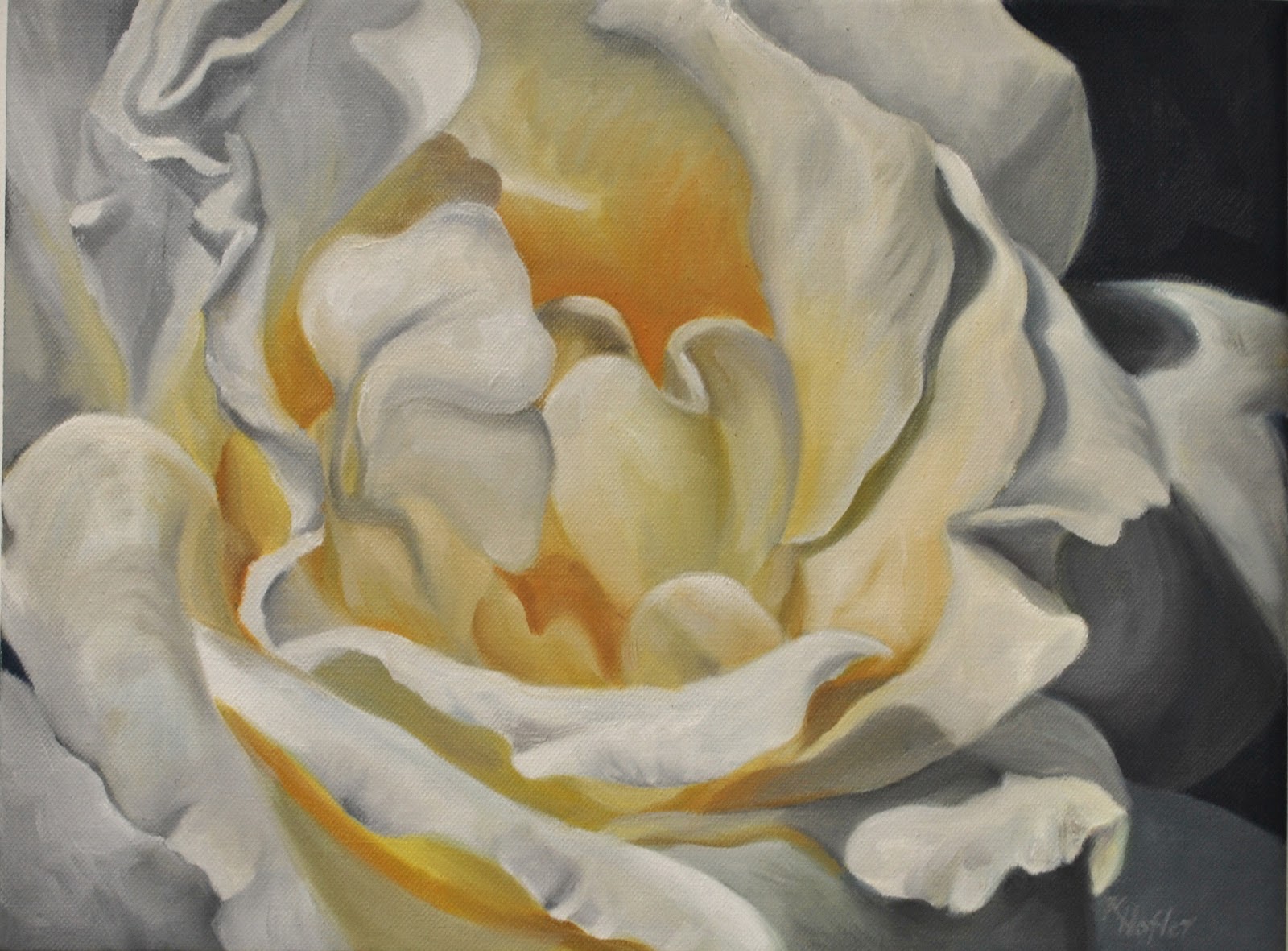
In the last blog, I wrote about the white rose painting and the importance of light and shadow and the use of high contrast.  The painting that I have included this time is another  in a series of white roses.  It is an oil painting, 16" x 20", painted from a personal photograph, now on view at The Artist Gallery in Virginia Beach.

Wednesday, April 18, 2012

Evening Rose

When painting white flowers, the power lies in the stark contrasts between the pure white areas of the flower and the almost dark cast shadows.  The reflective gold in the center creates a glowing appearance and brings the flower to life.  White on any object reflects the colors around it.  The Impressionists recognized this when they moved from dimly lit studios to the bright sunlight of outdoors.  What beauty and vibrancy they found in the shimmering sparkles of light on water or the dappling colors reflected on a frilly white dress.  One of my favorite paintings in the Chrysler Museum, the Daughters of Durand-Ruel, is an example.  It was painted by Renoir entirely out of doors with lively brushstrokes and a palette of dynamic and ever changing colors.

Monday, March 26, 2012

Succulents, My Favortie Subject

Succulents have thick fleshy leaves that retain water because they mostly grow in hot dry climates.  They also often grow in sandy or beachy areas which is where I live. 
Succulents come in hundreds of varieties and are grown worldwide.  I think of them as life sustaining because of their ability to offer thirst quenching liquid to a hot traveler. 
This painting was done from a photograph taken in California at Quail Park Botanical Gardens in Encinitas.  I wanted to paint this particular image because of the beautiful colors and shapes and had at first considered cropping the image to get just a few of the leaves.  I finally decided to include almost all of the plant in the painting and I think it worked.  I enjoy painting subjects with many complicated and overlapping shapes and contrasting colors and this painting definitely "fit the bill". 

Friday, February 17, 2012

Undulating Terrain

I have always enjoyed sewing and it was fun for me to combine that with my passion for painting.  These canvases were completed for the "Be There and Be Square" Exhibit at The Artists Gallery, a cooperative in Virginia Beach that I have belonged to since 1996.


The canvases were cut apart, stitched back together with some areas backed by cotton muslin.  A small slit was made in the areas that are backed and those areas are stuffed with polyster filling and the slits stitiched back together, sort of trapunto quilting style.

 
The canvas is then stretched onto a stretcher frame and each area painted with oils using shading and highlights to make each area appear three-dimensional.  The trick is that some areas are actually three-dimensional and some areas are flat, but are painted to look three-dimensional.  Each painting was placed in a floater type frame and they are meant to be hung as a group.